Canonical token bridge
The canonical token bridge is a pair of lock-and-mint contracts, one on the LinethLineth (Formerly the Linea Stack) The open-source ZK-rollup stack, codebase, and technical protocol that's the foundation of Linea Mainnet. Operators can deploy this stack to launch their own Ethereum-compatible L2 or L3 networks. network and one on its finalization layerFinalization layer The blockchain where a Lineth deployment submits proofs and state commitments for verification and hard finality. If the finalization layer is Ethereum (an L1), the deployment is an L2. If the finalization layer is Linea (an L2), the deployment is an L3., that bridges any ERC-20 token. It carries no cross-chain machinery of its own: every transfer is a message sent through the canonical message service, and inherits that service's verification and delivery model.
Native currency isn't bridged here. It moves through the message service directly, as the value attached to a message.
How it works
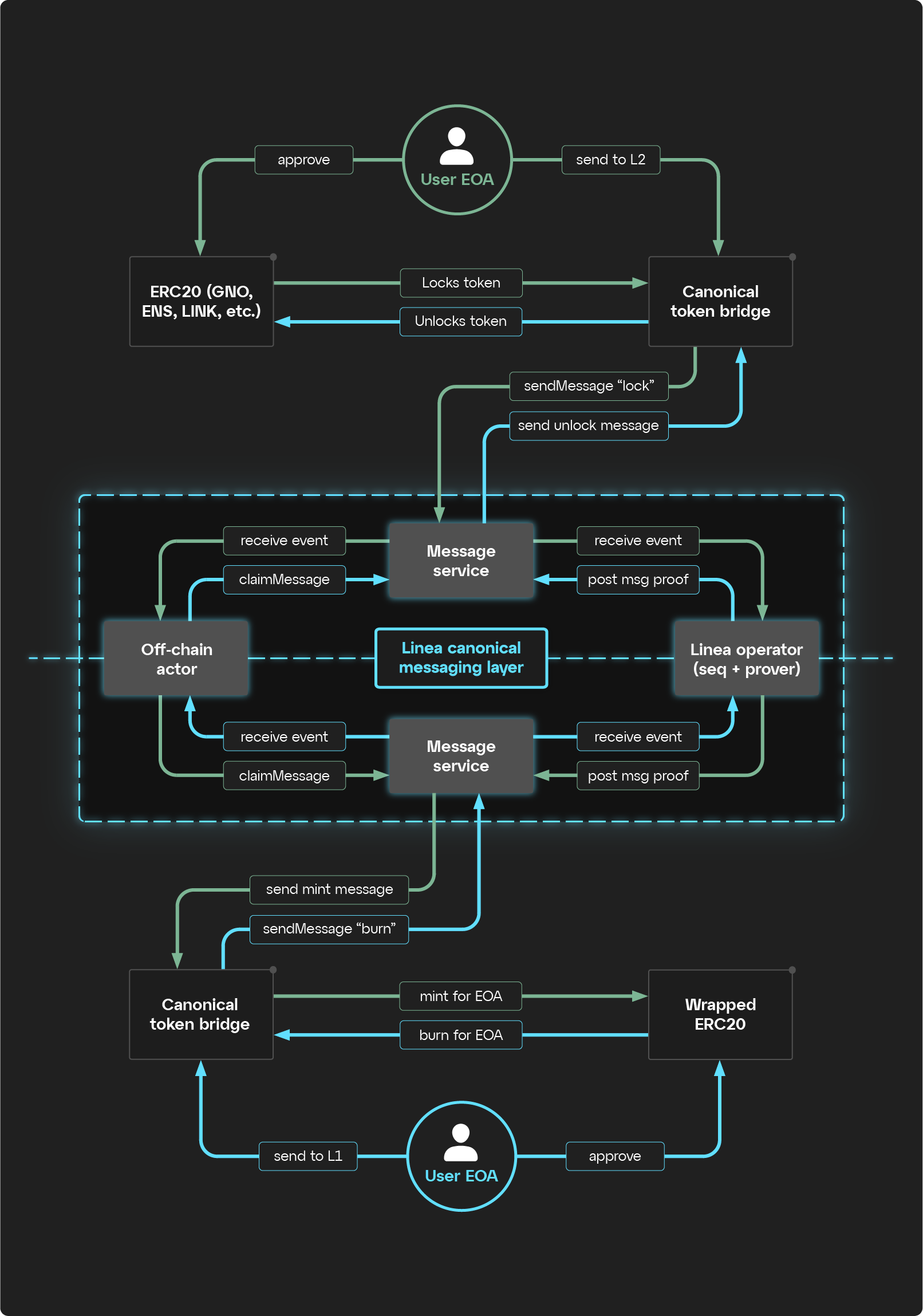
Bridging a token away from its original chain involves locking and minting as follows:
- The bridge escrows the tokens in its own contract and sends a message instructing the bridge on the destination chain to complete the transfer.
- That bridge mints an equivalent amount of a
BridgedToken, an ERC-20 it controls, to the recipient. The first time a given token is bridged, the destination bridge deploys theBridgedTokencontract for it, carrying over the escrowed token's name, symbol, and decimals.
Bridging back reverses this: the bridge burns the BridgedToken and sends a message releasing the escrowed
tokens on the original chain.
Because minted supply on one side is always matched by escrowed supply on the other, the bridge can't mint tokens
that were never locked.
Operators can reserve token addresses so they can't be bridged, which is how tokens that need a dedicated bridge are kept off the canonical one. A token can only be reserved before it has been bridged.
The following diagram illustrates a full round trip, including the message service steps that sit between the two bridge contracts:
See also
- See the bridge guide and contracts for the workflow, ABIs, and addresses on Linea Mainnet, and the Linea bridge for the public UI.
- See the token bridge source code
in the
lineth-monorepo.